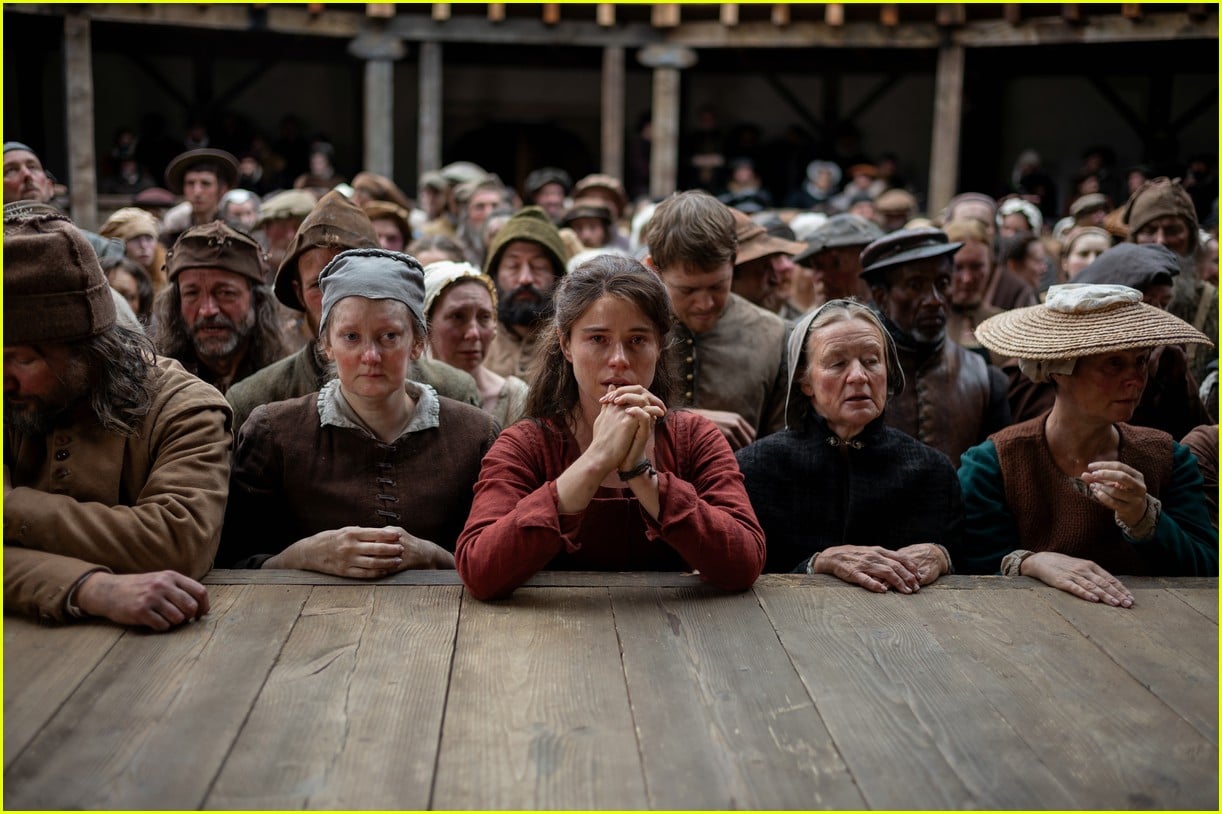
Trusting Chloé Zhao’s vision, I watched this film completely blindfolded, as I had no idea of the premise or who the main characters were. At the beginning, the title card stated Hamnet was used interchangeably with Hamlet. I could picture that this film is related to Hamlet and Shakespeare, but I didn’t know how exactly. Growing up outside of the English world, my knowledge of Shakespeare is limited: I’ve watched some versions and adaptations of some of his works, but I knew nothing of the personal life of the playwright himself. At the beginning of the final section, the full name ‘William Shakespeare’ was spoken for the first time by his wife while looking for him in the theater, which finally confirmed my suspicion. Up until that moment, the forename ‘William’ wasn’t mentioned or called by anyone. Therefore, every turn of how the main characters develop is unpredictable for me, without feeling that that boy, Hamnet, was born to die. My unknowing made the film a fresh drama, possibly different from lots of audiences’ viewing experiences.
The film begins with Agnes lying down on the ground of the forest and then calling a hawk to land on her forearm, while the variant shadows of green and Agnes’s crimson dress are blooming through the screen. We followed Agnes via a passage through the forest to an English cottage, where she met her future husband for the first time. The film doesn’t apply a stylish coloring filter that is often associated with historical periods but prefers the color scheme with natural lighting. We entered the world of Agnes as regular townsfolk, making the storytelling intimate without a prepositioned distance. The most stylizing movement of the camera is the rare slow zoom in, transmitting the mysteriousness of the masterful forest.
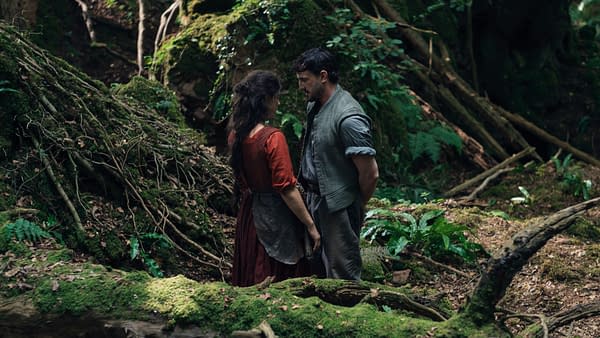
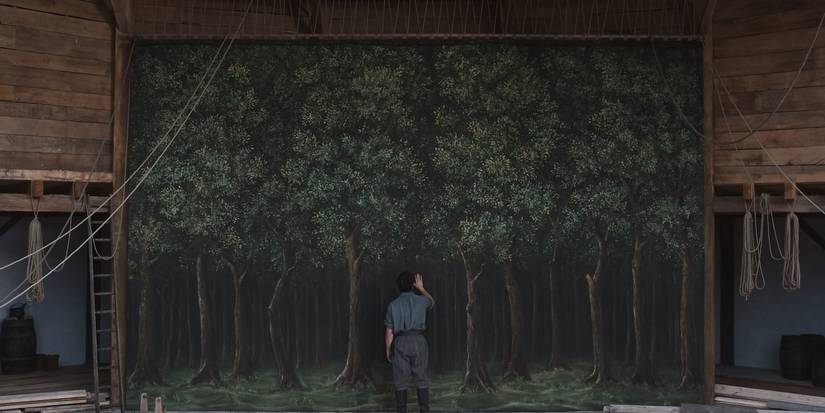
Even though both of the couple are the protagonists, we mostly follow the story through the eyes of Agnes instead of William Shakespeare. Hence, this film distances itself from an easy-to-explain biography of Shakespeare. The abusive patriarchy inside the family naturally surfaced, and so did the restrictions towards women at that period. Their voices are silenced, and their roles are limited to being a mother raising children. Idiosyncratic and assertive, Agnes was accused of being a daughter of a forest witch. It’s announced in the film that she rejected the religion in the church. Influenced by her mother, she practiced an omnipresent and cosmic form of spirituality connected with nature. She can use herbs for medical effects and see the visions of people by touching their hands. Aligning with the period, her social status was not more than the lady of the house, and her earnest pursuit was to fulfill the role of a mother. Nevertheless, her understanding of life, death, and the afterlife was alive and acted as an actual force towards the actions of this film. The first shot of this film is a magnificent grand tree, which Agnes was lying next to. The hollow of the tree gazed back at William, which later on was transformed into the stage design and then even a space for the afterlife. After she successfully gave birth to her first child alone by the tree, she was stopped by her mother-in-law and forced to give birth at home. More than a mere foreshadowing, the vision that Agnes saw with two children and the obstacles she faced while giving birth for the second time were painted as omens.
Agnes’s son, Hamnet, tricked Death to replace his twin sister and died for her before adolescence as a pure-hearted being. After the passing of Hamnet, the reference to Hamlet became direct. At Shakespeare’s suicidal moment, the famous ‘to be or not to be’ monologue was performed as a speech of catharsis for Shakespeare himself, which I found unserious and even humorous. The much more moving words were said in the daily conversations inside the family. Their words of love, support, and understanding for each other depict an almost unrealistic domestic environment, despite the conflicts. The last chapter is the premiere of Hamlet in the still-standing Globe Theatre in London. Agnes came to experience the consolation art could bring to grief in real life, which is a heartwarming promise of this film. The film ended with Max Richter’s representative piece—On the Nature of Daylight, which also plays a key role in Sorrentino’s The Great Beauty. This film brings the audience through the passage of time, where the obscure waves of life present with love, words, and herbs.
Comments