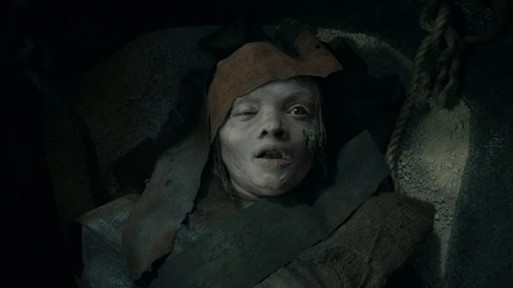
If you are going into Lee Cronin’s The Mummy (2026) and expecting a sophisticated classic like The Mummy (1932) with Boris Karloff, a fun monster romp like The Mummy (1959) with Peter Cushing, an Indiana Jones-style adventure like The Mummy (1999) with Brendan Frasier, or some mashup of those concepts like The Mummy (2017) with Tom Cruise, prepare to be disappointed on all fronts. The newest horror offering from Blumhouse Productions and New Line Cinema, giants in this space having produced films like Get Out (2017) and A Nightmare on Elm Street (1984) respectively, is just another generic demon possession movie.
When assessing a horror movie, most viewers want an answer to one primary question: is it scary? The answer, friends and neighbors, is yes. This film, one way or another, will probably freak you out. That mostly comes from hearty servings of loud noises, gore, and (fictional) cruelty towards children, coupled with a minor helping of (fictional) animal abuse. Nowhere in Lee Cronin’s The Mummy is there any horror that originates from a concept, a thought, some psychology. This is one of the most disgusting movies I have ever seen, and admittedly that is impressive, but all it lends itself to is the ten millionth iteration of the formula founded in 1973 by The Exorcist.
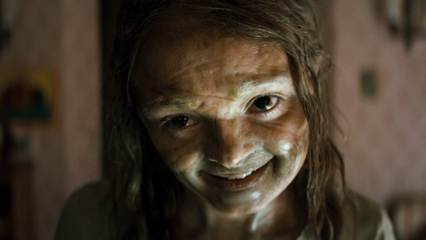
This film attempts, but ultimately fails, to deliver on diversity of its cast. The crux of this film’s plot is anchored in Egypt, yet the five most prominent characters are all Caucasian. The closest we have is Detective Dalia Zaki, played by Egyptian-Palestinian actress May Calamawy, who has a somewhat prominent role and is generally strong. However, her role is largely just to serve as the script’s mechanism for advancing the plot and relaying exposition to the real main characters. To the extent that she is anything more, her representation is outweighed by the main villain being played by Hayat Kamille, who is simply credited as “the Magician.” This isn’t to suggest that villains should never be played by minority ethnicities, but here, the contrast of the white protagonists with the mysterious, occult Middle Easterner plays on long defunct fears of the “oriental.” Perhaps this was not intended, and indeed it feels more like sloppiness than malice, but it ultimately discredits this film’s attempt to be diverse.
Veronica Falcon plays a grandmother character who is unapologetically Latina, and Laia Costa plays her daughter, the mother of the film. This Latin-American representation is welcomed, but it is poorly balanced. Veronica Falcon’s character is so overtly Catholic that it borders on cartoonish, while Laia Costa’s character lacks any sense of ethnic identity besides her accent and name. A more seasoned writer may have been able to craft characters that more naturally exist in their cultural contexts and contain more layers. Egyptians and Latin-Americans also feature prominently as extras in the film, but this ultimately feels like too little to truly call the film “diverse.”
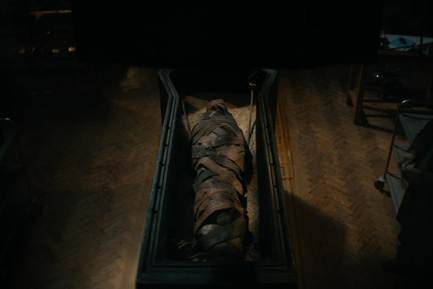
Overall, Lee Cronin’s The Mummy is plagued by numerous flaws, both from a quality and from a diversity standpoint. The film relies on gore and loud sounds to drown out its flat script, flatter dialogue, and one-dimensional characters. It attempts diversity in ways that seem tone deaf. It provides little else that hasn’t been previously provided by The Conjuring, Insidious, Sinister, or even last year’s Bring Her Back, a film with striking similarities to this. It succeeds at “freaking out” the audience, but little else, and this feels like a missed opportunity from the writer/director who brought us the superior Evil Dead Rise.
Comments