At its core, How to Divorce During the War is about how long one can hold onto their moral principles and empathy when personal comfort is at stake. With an almost clinical eye, it explores how much one is willing to sacrifice to help the less fortunate, and how quickly their principles can crumble when the sacrifices become more demanding.
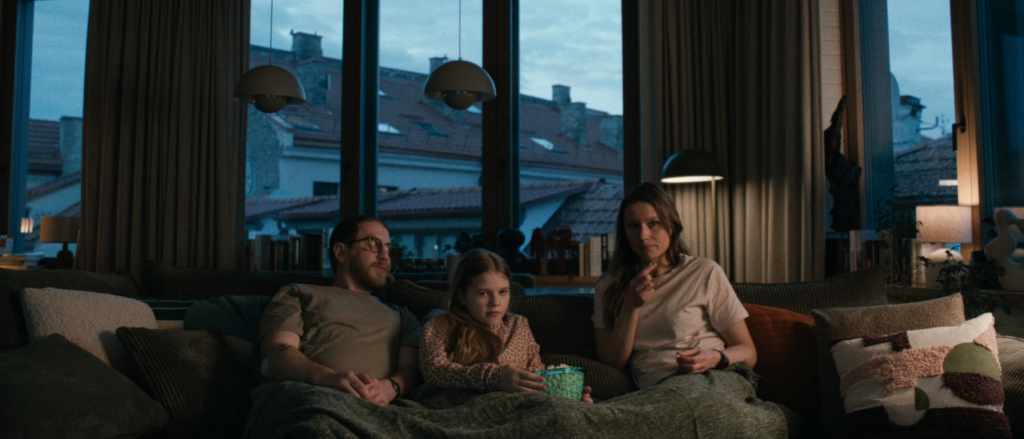
Set in Vilnius, the movie starts with Marija (Žygimantė Elena Jakštaitė), a media company executive, telling her husband Vytas (Marius Repšys), a former movie director turned stay-at-home dad, that she wants a divorce, just one day before Russia invades Ukraine. Their conflict is rooted in a quiet power imbalance and resentment over their reversed traditional gender roles. Directed in a deadpan tone by Andrius Blaževičius, and with great, believable performances from the main cast, How to Divorce During the War shifts its focus from what could’ve been a marriage drama to how the main characters deal with what’s happening in Ukraine. These sudden domestic and international changes allow both characters to act on their professed compassion. Marija quits her high-paying job because her company refuses to cut ties with Russia, and she takes in a family of Ukrainian refugees. Meanwhile, Vytas moves in with his parents and throws himself into the relief movement, volunteering to aid refugees and participating in public artistic displays protesting the war.

Because I live in a country that shares a small border with Ukraine, this movie resonated with me on far more levels than I expected. Like the characters in Vilnius, my community is constantly bombarded with Russian propaganda, and I know people exactly like Vytas’ elderly parents who actively believe it, just as there are children who, unquestioningly, follow their parents’ understanding of the world, much like Marija and Vytas’ daughter, Dovile. In the scene where Vytas physically removes his parents’ satellite antenna to stop them from listening to the propaganda, for a short while, his character stops looking like a washed-out artist trying to find a purpose and looks more like Superman. His preference for sleeping in the car and bathing in the lake rather than listening to more propaganda from his parents further illustrates his uncompromising adherence to his moral principles.

However, as the film moves along, these grand gestures are increasingly revealed as performative acts. Marija’s principles are tested when her own girlfriend asks to take her vacated corporate position; unable to handle the perceived betrayal, Marija breaks up with her. Even her hospitality toward the refugee family begins to sour under the weight of domestic reality. Parallel to her, Vytas’s activism begins to look more like a strategy to gain TV exposure than actual compassion for the victims of war. For both characters, the war becomes a convenient stage for moral posturing.
Their marriage, too, seems to have been built on a kind of performance. Marija’s resentment towards Vytas suggests that, deep down, she never fully embraced their reversal of traditional gender roles, despite having accepted it. The same could be said of Vytas. Once an established artist, he seems to have settled into the role of stay-at-home father, which feels less like a conscious commitment to parenthood than a convenient way of filling the void left by his declining artistic ambitions. Perhaps their entire relationship was built on a facade, with both of them playing roles they had never fully reconciled themselves with, long before the war began.
I loved the casual, matter-of-fact way the relationship between Marija and her coworker, Jurate (Indrė Patkauskaitė), is woven into the main story. Even though their affair began before the divorce, it doesn’t feel like a “coming-out” or midlife-crisis story; it’s just part of life. Their relationship isn’t romanticized or burdened with the hardships and identity struggles you’d typically expect from a movie about same-sex relationships. Marija may have her flaws, but her sexuality feels like an entirely accepted and unremarkable part of who she is. The irony here is that Marija’s queer relationship has a sense of normalcy attached to it, while her conventional marriage has become defined by resentment.
How to Divorce During the War perfectly balances its domestic drama with a broader examination of human nature and moral contradictions. Ultimately, it is less concerned with the dissolution of a marriage than with the dissolution of the ideals people construct around themselves. It asks an uncomfortable question: how much of our morality would survive if living by our principles actually required us to give something up?
Comments