
As the story goes, author Suzanne Collins was channel surfing late one night in the early 2000s. The images on screen flashed between news footage of the war in the Middle East and reality television shows. Eventually, Collins said, the images started to blur, and she envisioned a reality TV competition centered on war and violence. Thus, The Hunger Games books were born. Originally written only as a trilogy, two prequels would be released a decade later, all together painting a portrait of humans desensitizing each other to violence and the cost of entertainment.
Set in a semi-distant dystopian America, The Hunger Games series tells the story of the nation of Panem as they recover from a civil war between the Capitol, where the most politically and economically influential individuals reign with an iron fist, and the twelve districts that serve them. Every year since the conclusion of the war, each District is required to ship one boy and one girl from the ages of twelve to eighteen, who are selected via a lottery system called the Reaping, to the Capitol to fight until one is declared the lone victor. These Hunger Games are a reminder to the districts of the cost of rebellion and ensure that the Capitol’s boot remains firmly on the necks of its citizens.
The Hunger Games: Sunrise on the Reaping, directed by Francis Lawrence and adapted from the book of the same name by Collins, follows sixteen-year-old Haymitch Abernathy (Joseph Zada) as he attempts to survive his turn as a tribute in the 50th Hunger Games. As this is the fiftieth anniversary of the Games, there is a special rule instilled, as there is every quarter of a century. Unlike previous Games, instead of one boy and one girl tribute from each district, now two boys and two girls are reaped from each district.
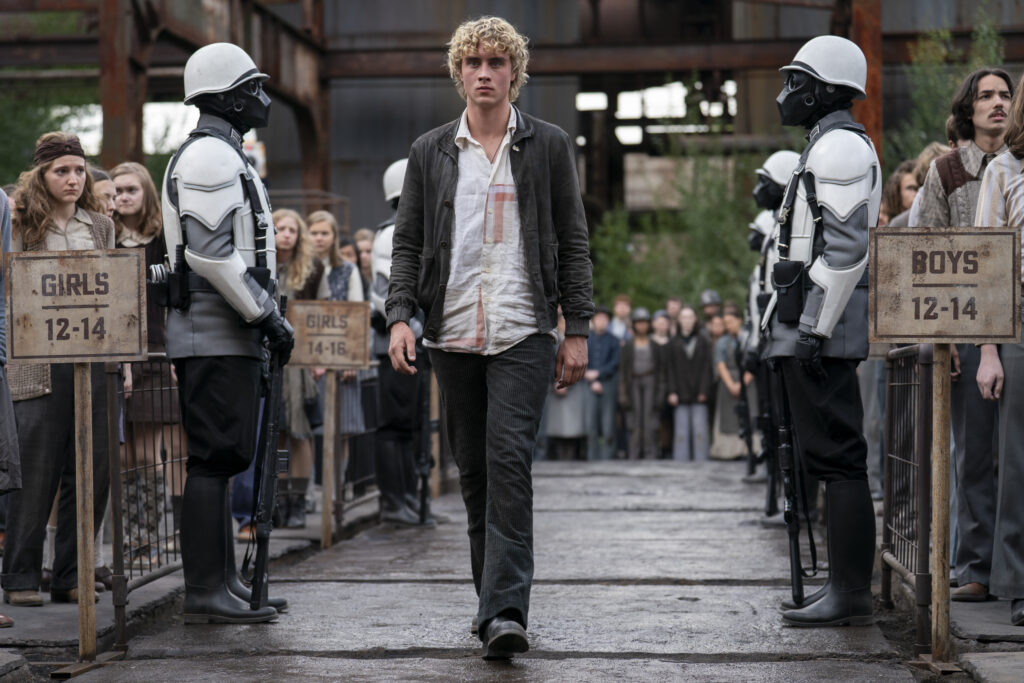
As Haymitch awakes on his sixteenth birthday, which coincides with Reaping Day, Sunrise on the Reaping tracks exactly how Haymitch is chosen for the Games. The film establishes his life before the Games, as he provides for his younger brother Sid (Smylie Bradwell), his mother (Kara Tointon), and plans his future with his girlfriend, Lenore Dove Baird (Whitney Peak). The latter of whom gifts him a flint striker and the advice that no part of the future is set in stone, so to believe every day is inevitable is to fall victim to the Capitol’s propaganda that nothing can change, including the existence of the Games.
This mentality, paired with his mother’s reminder not to let the Capitol control the narrative about his life, motivates Haymitch to commit to something bigger than himself. When the opportunity arises to destroy the Games permanently and defy the Capitol’s fascist leader, President Snow (Ralph Fiennes), all from within the walls of the arena, Haymitch takes it. He quickly learns he has bitten off more than he is prepared to chew as Snow shows him the real cost of rebellion.
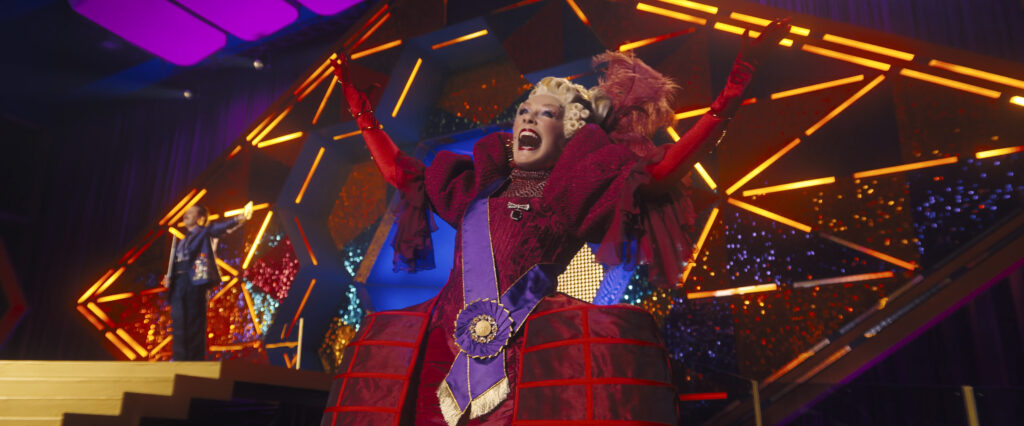
Cloaked in a 1970s-inspired production design, Sunrise on the Reaping stands out as the most visually vibrant of The Hunger Games titles, juxtaposing the violent and visceral subject matter with sparkle, chroma, and plenty of psychedelia. With cinematography led by Jo Willems, Sunrise on the Reaping manages to capture a time in Panem’s history that has never been seen before and, even after six films, keeps it fresh. Tied off with a bow by the outstanding cast of both fresh faces and household names, The Hunger Games: Sunrise on the Reaping is a satisfying entry into the Hunger Games cinematic universe.
Led by newcomer Joseph Zada, who gives a starmaking performance embodying sixteen-year-old Haymitch Abernathy, Sunrise on the Reaping boasts a masterful cast across the board. While the aged-up version of the character was played by Woody Harrelson in the original quadrilogy, Zada takes the reins of the younger iteration of Haymitch with ease. He replicates Harrelson’s gruff, aged voice as if it is his native accent, while maintaining a tangible fear throughout long sequences that require him to shake like a dog left out in the rain. In one shot, Zada covers part of his face with his arm, and for a moment, he seemingly disappears, and it feels like Harrelson’s face has plastered itself on Zada’s. All of it, a testament to the premier casting in this film.

The other uniqueness offered with Zada’s casting is that the franchise is able to subtly correct its own mistakes of the past. It is argued amongst fans that in Collins’ original novels some of the central characters are described as potential descendants of Indigenous Americans, including Haymitch. When Lionsgate cast the original film in the 2010s, they opted not to focus on hiring actors with an Indigenous background, including with Haymitch’s character. But when finding a younger Haymitch, Lionsgate would actually cast a descendant of Indigenous people in Zada, who has discussed his Aboriginal background and how it influenced him to change his stage name to honor those roots. While it was likely just coincidence, it is never a bad thing to correct the errors of the past and give Indigenous people and their descendants the platform to tell their own stories, even if it is happenstance.
With over four hundred pages of a novel to adapt, Sunrise on the Reaping does struggle with having too much on its plate. The pace of this adaptation is breakneck, and a number of story beats happen so quickly that it ends up feeling overwhelming and leaves only a few moments for the script and characters to breathe. Some of the best sequences are the ones where the movie takes a much-needed break and highlights character dynamics and relationships. Like when Maysilee Donner (McKenna Grace), one of the female tributes from Haymitch’s district, has an emotional sit-down with him in the arena. The two children express their desire to control the narratives of their lives, rather than letting the Capitol co-opt them for fascist propaganda, in a moment of relatable realism.

This topic of conversation is a beautifully realistic part of the film, because, of course, after everything that they have endured, the only thing these children have left to their names is their story. But they fear even that will be ripped away from them, changed by the Capitol, and misinterpreted by all. The only solace they find is in knowing that the other can testify to the truth, and so Haymitch and Maysilee bond in their shared fear. Sadly, there are only a handful of heartfelt moments like this in Sunrise on the Reaping because of how much material the filmmakers have to cram into the two-and-a-half-hour runtime. There is no doubt that these kinds of sequences will age the best for audiences, because they are collective experiences for humans, whether in fact or fantasy.
Overall, a dutiful adaptation of Suzanne Collins’ bestselling novel, The Hunger Games: Sunrise on the Reaping offers the welcome familiarity of the Games blended with electric visuals, fantastic performances all around, and an always relevant message to inspire the next generation of rebels. The only real issue with this film is that, for a two-and-a-half-hour flick, there should be just a bit more time spent on those slow moments between characters. Especially when they relatably ponder the impact they leave behind and fear its misappropriation at the hands of those with malicious intent.
Comments